
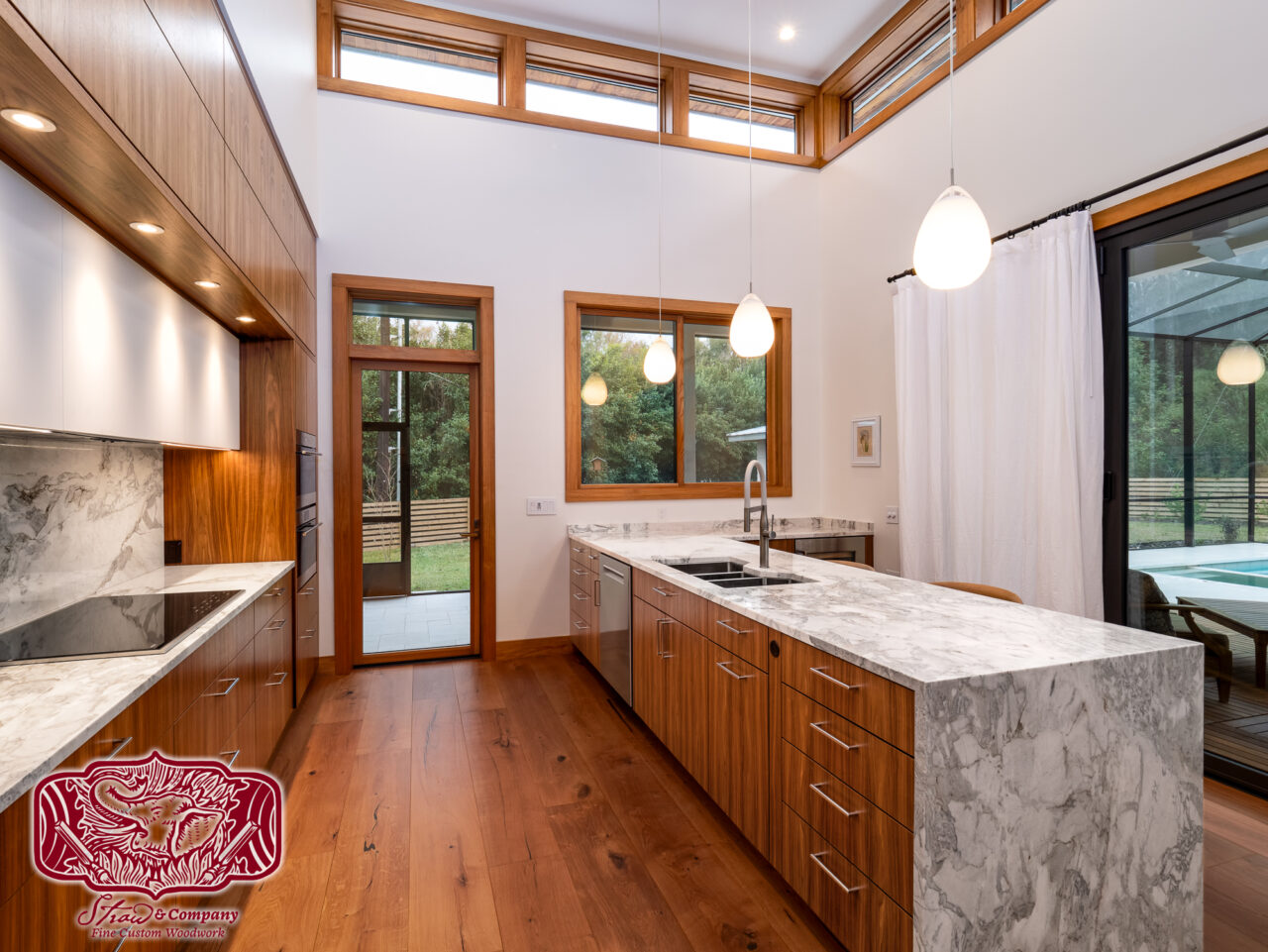
When homeowners begin planning a kitchen renovation or bathroom remodel, the conversation about cabinetry almost always arrives at the same question: is custom cabinetry worth the additional investment over stock or semi-custom options? It is a fair question. Custom cabinetry costs more upfront, and in a renovation where budgets are already under pressure from multiple directions, the difference in price between production and custom can feel difficult to justify.
But the question itself is often framed incorrectly. The real question is not whether custom cabinetry costs more. It does. The real question is what that additional investment delivers — in quality, in fit, in longevity, and in the way the finished space looks and functions every single day. When the comparison is made on those terms, the case for custom cabinetry becomes considerably more compelling.
Built for Your Space, Not Adapted to It
The most fundamental difference between custom cabinetry and every other option is that custom cabinetry is designed and built for your specific space. Every cabinet box is sized to fit the actual dimensions of your room — not the nearest standard size available in a production catalog.
This distinction matters more than most homeowners realize until they have lived with the alternative. Stock cabinetry is manufactured in fixed increments — typically three-inch width intervals — and installed kitchens and bathrooms are almost never perfectly divisible by those increments. The result is filler strips, awkward gaps, and compromises in layout that affect both the appearance and the function of the finished space.
Custom cabinetry eliminates those compromises entirely. If your kitchen is 14 feet and 7 inches wide, your cabinetry is built to 14 feet and 7 inches. Every cabinet is proportioned correctly for the space it occupies, and the finished result looks like it was always meant to be there — because it was designed to be.
This precision extends beyond width. Custom cabinetry accounts for out-of-plumb walls, uneven floors, architectural details like beams and soffits, and the specific requirements of appliance integration. A custom cabinet maker measures, accounts for, and resolves every variable in your specific space before a single piece of material is cut.
Material Quality That Production Cabinetry Cannot Match
Stock and semi-custom cabinetry is manufactured to meet price points. The materials used — the substrate of the cabinet box, the quality of the door construction, the thickness of the veneer or laminate, the grade of the hardware — are all selected to allow the product to be sold at a competitive retail price. This is not a criticism. It is simply the reality of how production manufacturing works.
Custom cabinetry is built to a quality standard rather than a price point. The substrate is chosen for the specific application — whether that means furniture-grade plywood for the cabinet box, MDF for painted door faces, or wood veneer over a stable engineered core for a natural wood finish. The construction method is selected for long-term performance rather than manufacturing efficiency. The hardware is specified for durability and smooth operation over decades of daily use rather than for its cost at scale.
The difference in material quality between production and custom cabinetry is not always visible on the day of installation. It becomes visible over time — in doors that hold their shape rather than warping, in finishes that remain consistent rather than yellowing or delaminating, in drawer systems that operate smoothly after ten years of use rather than beginning to fail after two or three.
Storage Designed Around How You Actually Live
Production cabinetry offers a fixed range of interior configurations. You choose from what is available and organize your belongings around the constraints of the cabinet rather than designing the cabinet around your needs.
Custom cabinetry inverts that relationship entirely. The interior of every cabinet is designed around how you actually use your kitchen or bathroom. Drawer inserts sized for your specific cookware. Pull-out shelves positioned at the depth that suits your pantry storage. A drawer stack in the location that makes the most ergonomic sense for your workflow. A vanity interior configured for the exact combination of items you store there every day.
This level of personalization is not a luxury detail. It is the difference between cabinetry that makes a space genuinely more functional and cabinetry that simply occupies the space. In a kitchen where the same storage is accessed multiple times every day, the cumulative effect of well-designed interior organization is significant — in time saved, in frustration avoided, and in the simple daily pleasure of a space that works the way it should.
Longevity That Changes the Financial Equation
The upfront cost of custom cabinetry is higher than production alternatives. But the financial comparison between the two is incomplete if it only accounts for the initial purchase price.
Quality custom cabinetry, built from the right materials and finished correctly, has a functional lifespan measured in decades. It does not need to be replaced when a kitchen is refreshed. Doors and drawer fronts can be refinished or replaced while the cabinet boxes remain in place. Hardware can be updated. The bones of the kitchen — the structure that defines its layout and proportion — remain sound and serviceable for the life of the home.
Production cabinetry has a shorter functional lifespan. The materials and construction methods used to meet retail price points are not engineered for decades of daily use in a kitchen environment. When production cabinetry begins to fail — through warping, delamination, hardware breakdown, or structural compromise — the remedy is often replacement rather than repair. The cost of that replacement, factored against the original savings, frequently closes or reverses the financial gap between production and custom.
The Resale Value of a Well-Designed Kitchen
A kitchen is consistently among the highest-return renovation investments in residential real estate. But not all kitchen renovations return equal value. A kitchen with quality custom cabinetry — one that is clearly well-built, well-proportioned, and finished with care — communicates something to a prospective buyer that a kitchen with production cabinetry simply does not.
It communicates that the home has been maintained and improved to a high standard. It signals quality throughout. And in a competitive real estate market, that signal translates into buyer confidence, stronger offers, and a faster sale.
Custom cabinetry is not just an investment in how you live in your home today. It is an investment in the value of the home itself — one that compounds over time as the quality of the materials and construction becomes more apparent with every passing year.
The Right Cabinet Maker Makes the Difference
Custom cabinetry is only as good as the cabinet maker who builds it. The value of the investment depends entirely on the quality of the design process, the materials selected, the precision of the construction, and the care taken during installation.
Working with a cabinet maker who asks the right questions, who understands how design decisions affect long-term performance, and who builds every cabinet to a consistent standard of quality is what separates a custom cabinetry investment that delivers lasting value from one that simply costs more than a production alternative.
The difference between good and exceptional custom cabinetry is craft. And craft, in cabinetry as in anything else, is always worth investing in.
Straw Woodwork designs and builds custom cabinetry for kitchens, bathrooms, and living spaces throughout the region. If you are ready to invest in cabinetry built to last, we would love to talk about your project.