
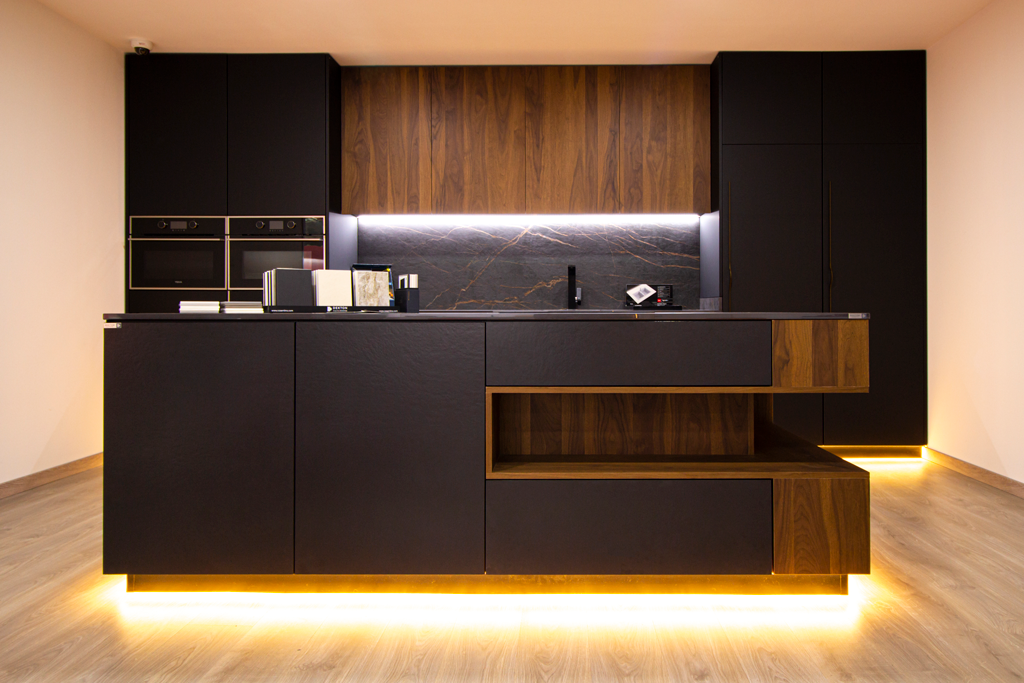
The Italian kitchen has long represented the highest standard in residential design. It is not simply a matter of aesthetics — though the aesthetics are undeniably compelling — it is a philosophy of design that treats the kitchen as the most important room in the home and approaches its construction accordingly. Italian-inspired custom kitchen cabinet design brings that philosophy into any home, combining refined proportions, exceptional materials, and a level of craft that is immediately apparent and impossible to replicate at a production level.
For homeowners planning a luxury kitchen renovation, understanding what defines Italian-inspired cabinet design — and what it demands in terms of construction and material quality — is the foundation of making decisions that will stand the test of time.
The Design Philosophy Behind the Italian Kitchen
Italian kitchen design is rooted in a set of principles that have remained consistent for decades despite shifting trends. The first is proportion. Italian design treats the kitchen as an architectural composition rather than a collection of individual cabinets. Every element — the height of the upper cabinets, the depth of the base cabinets, the relationship between the island and the perimeter cabinetry, the spacing of hardware — is considered in relation to everything else. Nothing is arbitrary.
The second principle is material integrity. Italian-inspired design does not use materials to imitate other materials. Wood looks like wood. Lacquer looks like lacquer. Stone looks like stone. The authenticity of each material is respected and expressed rather than concealed or approximated. This commitment to material honesty is one of the reasons Italian-inspired kitchens age so gracefully — they do not rely on surface effects that fade or date.
The third principle is restraint. Luxury in Italian design is communicated through quality rather than quantity. A single run of beautifully proportioned cabinets in a flawless high-gloss lacquer finish communicates more sophistication than an elaborate kitchen filled with decorative detail and ornament. Less, when executed with exceptional craft, is always more.
High-Gloss Lacquer: The Signature Finish of Italian-Inspired Cabinetry
No finish is more closely associated with Italian-inspired kitchen design than high-gloss lacquer. Applied to flat panel doors over an MDF substrate, a properly executed high-gloss lacquer finish produces a surface that is mirror-smooth, intensely reflective, and extraordinarily demanding to achieve at a high standard.
The appeal of high-gloss lacquer in a kitchen is both visual and spatial. The reflective surface bounces light around the room, making the space feel brighter and larger. In a kitchen with carefully considered lighting, high-gloss lacquer cabinet doors become part of the light design of the room — picking up and distributing light in a way that matte finishes simply cannot.
The color palette associated with Italian-inspired high-gloss lacquer runs from the purest whites and off-whites through deep charcoals, warm taupes, and rich jewel tones. Each color reads differently in gloss — whites become luminous, dark colors become deeply saturated and almost lacquer-like in their depth. The choice of color in a high-gloss Italian-inspired kitchen is a significant design decision that should be made in the context of the room’s natural light, architectural finishes, and overall material palette.
Achieving a true high-gloss lacquer finish at the quality level associated with Italian-inspired design requires multiple application and sanding cycles, a dust-controlled finishing environment, and a level of technical skill that separates genuine custom cabinet makers from production shops attempting to approximate the look.
Natural Stone and Wood: Grounding Luxury in Warmth
While high-gloss lacquer is the signature finish of Italian-inspired kitchen design, the most sophisticated expressions of this aesthetic balance the lacquer’s reflectivity with the warmth and texture of natural materials. Natural stone countertops — marble, quartzite, or bookmatched stone slabs — bring organic variation and tactile richness to a kitchen that might otherwise feel too perfect and cold.
Wood veneer elements serve a similar purpose. A kitchen island faced in a warm walnut or European oak veneer against a run of white or grey high-gloss lacquer perimeter cabinets creates a contrast that is both visually dynamic and deeply satisfying. The wood grounds the lacquer, the lacquer elevates the wood, and the two materials together produce a result that neither could achieve alone.
This interplay between the refined and the natural is central to the Italian design sensibility. It is what prevents an Italian-inspired kitchen from feeling sterile or showroom-like and what gives it the warmth and livability that makes it a genuinely pleasurable space to spend time in.
Integrated Appliances and the Seamless Kitchen
One of the defining characteristics of Italian-inspired kitchen design is the integration of appliances behind matching cabinet panels. Refrigerators, dishwashers, and in some cases ovens and warming drawers are concealed behind doors and drawer fronts that match the surrounding cabinetry exactly — in finish, in grain direction if wood veneer is used, and in hardware detail.
The result is a kitchen where the appliances disappear into the composition. The eye reads a continuous surface of cabinetry rather than a collection of different objects occupying the same space. This level of visual coherence is one of the most powerful tools in achieving the seamless, architectural quality that defines Italian-inspired kitchen design at its best.
Achieving true appliance integration requires careful planning and precise construction. The cabinet boxes that house integrated appliances must be built to exact tolerances, the panels must align perfectly with the surrounding doors and drawers, and the hardware must be consistent across every surface. This is work that demands a custom cabinet maker with experience in integrated appliance design — it is not a detail that can be improvised during installation.
Hardware as a Design Statement
In Italian-inspired kitchen design, hardware is never an afterthought. It is a design element in its own right, chosen with the same care as the cabinet finish and the countertop material. The options range from recessed finger pulls machined directly into the door edge — creating a completely handle-free surface — to long, architectural bar pulls in brushed brass, matte black, or satin nickel that run the full height of a door or the full width of a drawer front.
Each hardware choice communicates a different design intent. Handleless doors push the aesthetic toward the most minimal and architectural expression of Italian design. Long vertical pulls add a sense of scale and drama. The choice should be made in relation to the proportions of the doors, the finish of the cabinetry, and the other metal finishes present in the kitchen — plumbing fixtures, lighting hardware, and appliance trim.
In a luxury Italian-inspired kitchen, the hardware is the punctuation of the design. It should be chosen last, after all other decisions are made, and it should feel inevitable — as though no other choice could have been right.
Why Custom Construction Is the Only Path to Authentic Italian-Inspired Design
Italian-inspired kitchen design cannot be achieved through production cabinetry. The proportions, the finish quality, the material choices, the appliance integration, and the hardware detail that define this aesthetic all require a level of customization and craft that production manufacturing is not designed to deliver.
A custom cabinet maker approaches an Italian-inspired kitchen as a single unified composition. Every decision is made in relation to every other decision. The result is a kitchen that has the coherence, the quality, and the quiet confidence that Italian design has always represented — a space that does not need to announce itself because its quality speaks clearly on its own.
Straw Woodwork builds custom Italian-inspired kitchen cabinetry with the material quality and construction precision this aesthetic demands. If you are planning a luxury kitchen renovation, we would love to hear about your vision.