
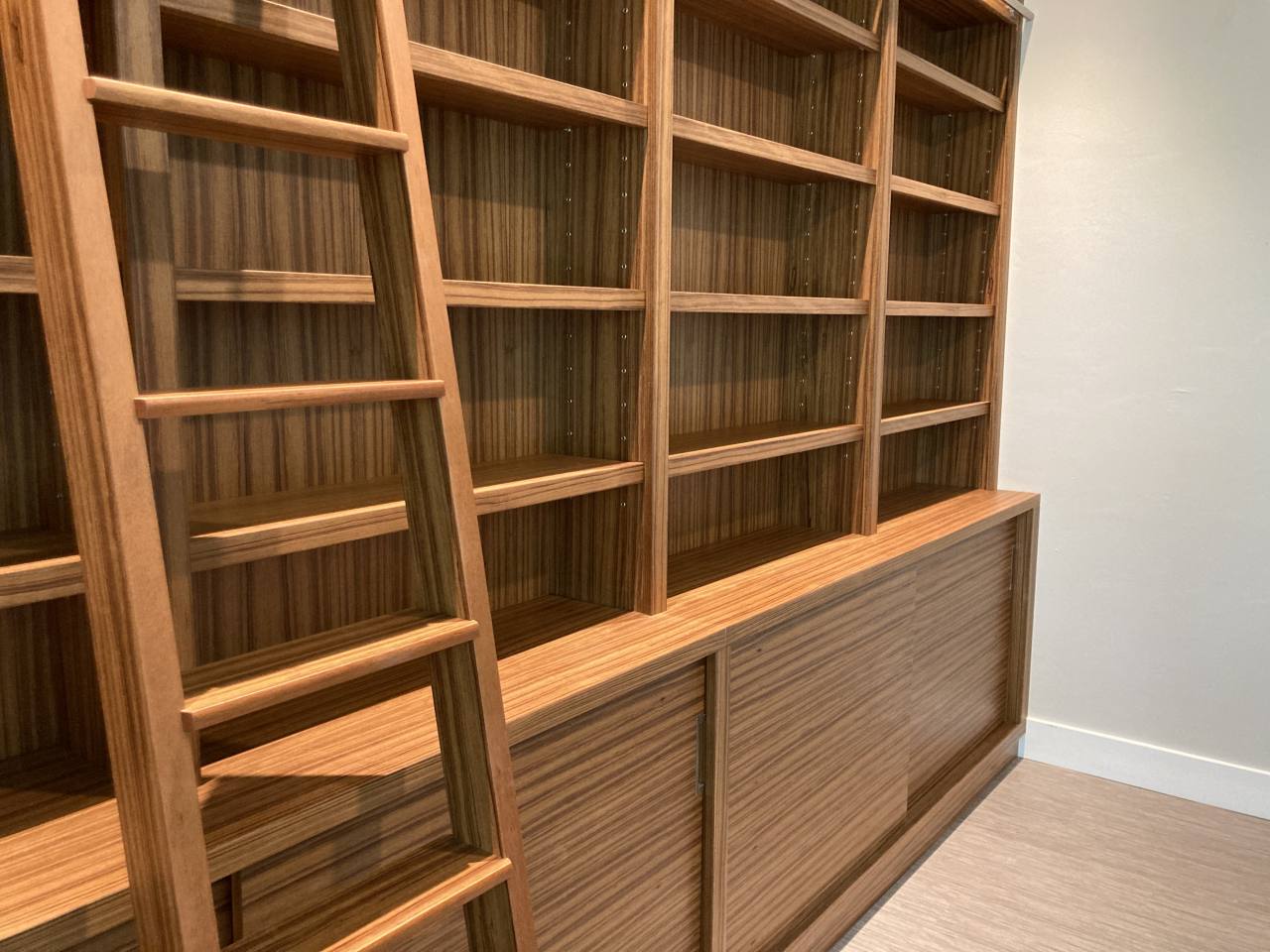
A custom library is one of the most enduring and personally meaningful investments available in residential cabinetry. It is not a trend-driven addition that dates quickly or a purely functional installation that serves a single purpose. A well-designed custom library transforms a room architecturally, creates a space that reflects the personality and intellectual life of the people who inhabit it, and delivers a level of craft and permanence that freestanding furniture and production shelving simply cannot approach.
Whether it is a dedicated home library, a study lined with floor-to-ceiling bookcases, a living room wall of built-in shelving, or a reading nook carved out of an underutilized corner, custom library design brings together proportion, material quality, and craftsmanship in a way that elevates any room it enters.
Why Custom Library Design Is Fundamentally Different
The difference between a custom library and a production shelving system is not simply a matter of quality — though the quality difference is significant. It is a matter of design intent. Production shelving systems are designed to fit into rooms. Custom libraries are designed to become part of them.
A custom library built-in is designed around the specific architecture of the room it occupies. It accounts for ceiling height, window placement, door swings, existing trim profiles, and the proportional relationships between the wall it occupies and the other elements in the space. The result is a library that looks as though it has always been there — as though the room was designed around it rather than the shelving added to it afterward.
This level of architectural integration is impossible to achieve with freestanding furniture or modular production systems, regardless of their quality. The gap between the top of a bookcase and the ceiling, the visible side panel that does not quite meet the adjacent wall, the baseboard that runs behind rather than through the unit — these are the details that reveal a production solution and prevent it from ever fully becoming part of the room.
Floor-to-Ceiling Design: The Most Powerful Statement in Library Design
Floor-to-ceiling bookcases are the defining element of a serious custom library, and for good reason. When shelving runs from the floor to the ceiling without interruption, it transforms the wall into a unified architectural composition. The room gains height, the books and objects displayed become part of the design rather than accessories to it, and the overall effect is one of permanence and intentionality that no other residential cabinetry installation can quite match.
The design of floor-to-ceiling library built-ins requires careful attention to proportion. The relationship between shelf height and shelf depth, the visual weight of the vertical dividers between bays, the profile of the cornice detail at the ceiling, and the design of the base that connects the unit to the floor all contribute to whether the finished library feels resolved and considered or merely tall.
In rooms with standard ceiling heights, floor-to-ceiling built-ins typically include a combination of open shelving in the upper section and closed cabinet storage in the lower section. The closed base cabinets provide concealed storage for items that do not need to be displayed — media equipment, files, supplies, seasonal items — while keeping the visual focus on the open shelving above. The transition between the closed lower section and the open upper section is one of the most important design decisions in a floor-to-ceiling library, and it deserves careful thought about both proportion and detail.
In rooms with higher ceilings, a library ladder running on a rail system is both a practical necessity for reaching upper shelves and one of the most evocative details available in residential design. A well-chosen library ladder — in solid brass hardware, in a wood that complements the shelving, running on a rail that is integrated into the cornice detail — transforms a library from a storage solution into a genuine architectural feature.
Material Selection: Wood Species and Finish in Library Design
The material choices made in a custom library have a direct and lasting impact on the character of the room. A library built in white oak with a natural oil finish communicates something fundamentally different from a library built in painted MDF with a high-gloss lacquer. Neither is wrong — they simply express different design intentions and suit different room aesthetics.
For traditional and transitional libraries, hardwoods with rich grain and warm color are the natural choice. Walnut produces a library of deep, sophisticated warmth — its color darkens beautifully with age and its grain figure rewards close inspection. Cherry offers a lighter, warmer tone that develops a rich patina over time, making it one of the most satisfying wood choices for a library that is meant to age gracefully. White oak brings a more neutral, contemporary quality to a library while retaining the warmth and authenticity of natural wood.
For contemporary libraries, painted finishes in carefully chosen colors can produce results of extraordinary refinement. A library painted in a deep, complex color — a warm charcoal, a rich navy, a muted sage — with carefully detailed shelving and a contrasting interior back panel creates a room with genuine drama and sophistication. The key to a painted library built-in is the quality of the finish system — a cabinet-grade catalyzed finish that produces a smooth, durable surface capable of handling the daily contact that library shelving receives.
Grain matched and sequenced real wood veneer brings the highest level of material craft to a custom library. When the veneer is sequenced across the vertical panels, door fronts, and shelf edges of a library built-in, the wood reads as a continuous composition rather than a collection of individual components. The grain flows from one panel to the next with an intentionality that communicates genuine craftsmanship and elevates the finished library from fine cabinetry to something closer to furniture making at its highest level.
Lighting: The Detail That Brings a Library to Life
Lighting is one of the most transformative details available in custom library design, and it is one of the most commonly overlooked until the shelving is already installed. A well-lit library is a fundamentally different experience from an unlit one — not just practically, but atmospherically.
Integrated LED lighting within the library built-in can take several forms. Shelf lighting — LED strips mounted at the front edge of each shelf, directed downward onto the books and objects below — creates a warm, layered effect that makes the library feel inhabited and alive even when the room’s overhead lighting is off. Cabinet interior lighting illuminates the contents of closed lower cabinets and makes them genuinely usable rather than dark and inaccessible.
Picture lights or directional spots mounted in the cornice detail at the top of the unit can wash the face of the shelving with light, emphasizing the depth of the bays and the texture of the books and objects displayed. In a library with high ceilings, this type of lighting draws the eye upward and reinforces the architectural scale of the installation.
The most important principle in library lighting design is that it should be planned before the built-in is constructed, not added afterward. Wiring channels, LED driver locations, and switch positions can all be integrated into the cabinetry during construction in a way that makes the finished installation look completely intentional — because it was.
Display and Storage: Designing for How a Library Is Actually Used
A custom library is not just a place to store books. It is a space that reflects the intellectual and personal life of the people who use it, and its design should account for the full range of what will be displayed and stored within it.
Open shelving is the natural home for books, but the proportions of the shelves matter. Shelves designed exclusively for standard book heights waste space and look rigid. A library designed with a range of shelf heights — some sized for tall art books and oversized volumes, some for standard hardcovers and paperbacks, some deliberately open for objects, artwork, and personal items — feels genuinely curated rather than purely functional.
Integrated display niches, framed openings within the shelving composition, and dedicated spaces for artwork or sculpture add a layer of design sophistication that distinguishes a thoughtfully designed library from a room that simply has a lot of shelves. These details require planning during the design phase and cannot be retrofitted into a completed installation.
Closed storage within the library — whether in base cabinets, in cabinets integrated into the shelving above, or in a dedicated media section — should be designed with the same intentionality as the open shelving. The proportion of open to closed storage, the placement of closed sections within the overall composition, and the detail of the door design all contribute to whether the library reads as a unified architectural element or a combination of mismatched storage solutions.
A Room Worth Designing Well
A custom library is one of the few residential investments that genuinely improves with time. The books accumulate, the wood develops its patina, the objects and art collected over years find their places on the shelves, and the room becomes increasingly personal and irreplaceable. It is a space that rewards the investment made in its design and construction every time it is used — which, in a well-designed library, is every single day.
Straw Woodwork designs and builds custom library built-ins for homeowners who want shelving that becomes a permanent and meaningful part of their home. If you are ready to bring a custom library to life, we would love to talk about your project.