
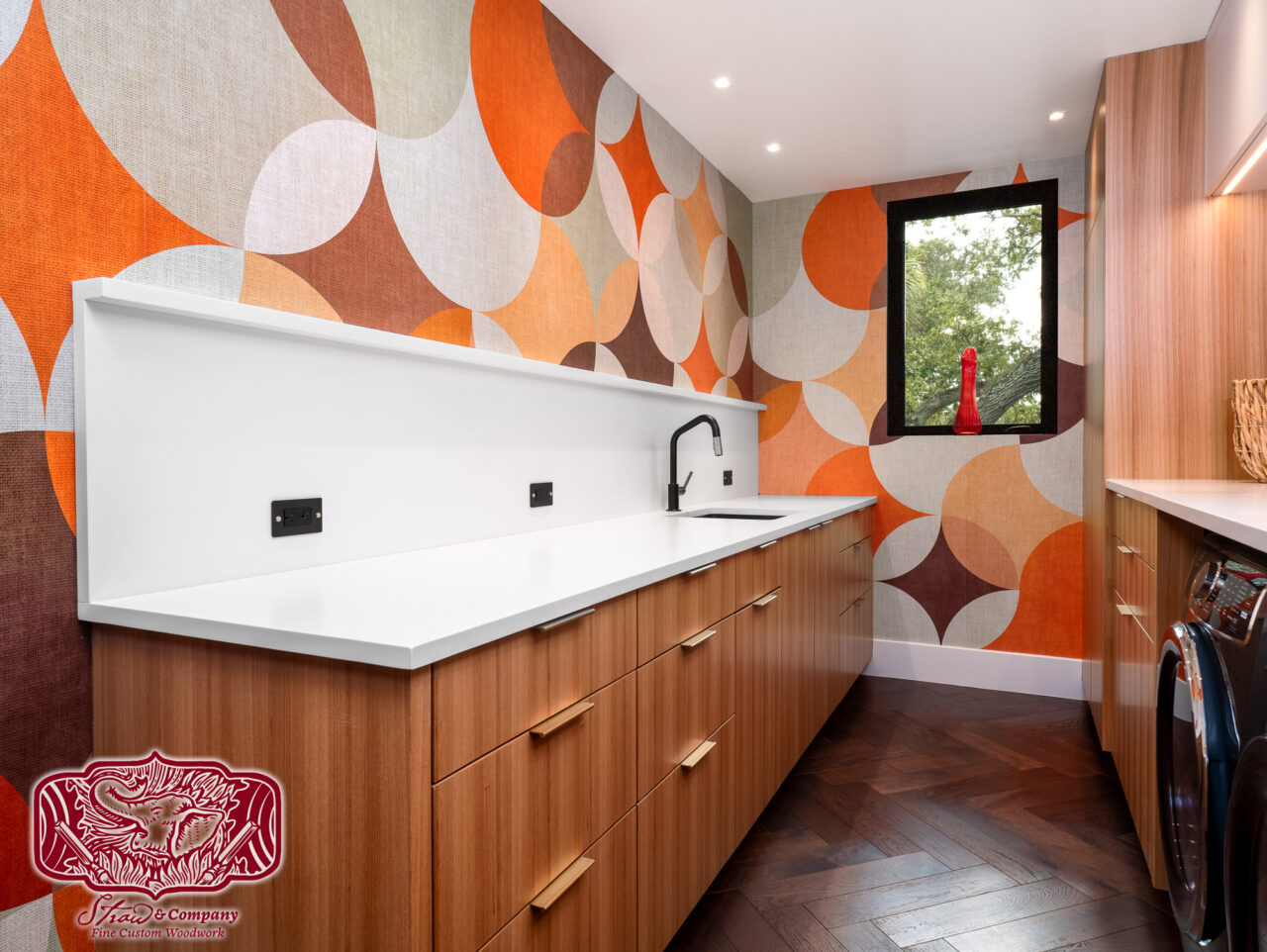
Wood grain is one of the most powerful design tools available in custom cabinetry, and in flat panel cabinet design it plays an outsized role. Unlike door styles with raised panels, decorative profiles, or painted finishes that draw the eye through visual complexity, a flat panel door in a natural wood veneer presents the grain as the primary — and often only — visual element on its surface. The direction that grain runs, the way it is matched across doors and drawers, and the species and cut of veneer chosen all have a direct and significant impact on how a kitchen looks and feels.
For homeowners planning a contemporary kitchen with wood veneer flat panel cabinets, understanding grain direction is not a technical detail to leave entirely to the cabinet maker. It is a design decision that shapes the character of the entire room.
What Grain Direction Actually Means
Every piece of wood has a grain — the linear pattern created by the growth rings and fiber structure of the tree as it is sliced into veneer or milled into lumber. The direction that grain runs on a cabinet door face is determined by how the veneer is oriented when the door is built.
The two primary orientations are vertical grain and horizontal grain. Vertical grain runs from the top of the door to the bottom, parallel to the vertical edges of the cabinet. Horizontal grain runs from left to right, parallel to the top and bottom edges. Each orientation produces a fundamentally different visual effect, and the choice between them is one of the most consequential decisions in a wood veneer flat panel kitchen.
There is no universally correct answer. The right choice depends on the proportions of the kitchen, the height of the cabinets, the species and figure of the veneer, and the overall design intent. What matters is that the decision is made deliberately rather than by default.
Vertical Grain: Height, Formality, and Visual Structure
Vertical grain is the more traditional of the two orientations and remains the most common default in production cabinetry. When grain runs vertically on a flat panel door, the eye follows it upward, which emphasizes the height of the cabinet and gives the kitchen a sense of verticality and structure.
In kitchens with standard ceiling heights, vertical grain can make the cabinetry feel taller and the room feel more generous. In kitchens where the upper cabinets extend to the ceiling, vertical grain creates a strong upward movement that reinforces the architectural intent of the design.
Vertical grain also tends to read as more formal and composed. The regularity of lines running parallel to the cabinet edges gives the surface a disciplined quality that suits kitchens with a refined, precise aesthetic. For a contemporary kitchen where order and geometry are central to the design language, vertical grain often feels like the natural choice.
The challenge with vertical grain in a multi-door kitchen is consistency. Because each door is cut from veneer with its own character, achieving a coherent vertical grain pattern across a long run of upper or lower cabinets requires careful veneer selection and sequencing. A cabinet maker who does not pay close attention to this can produce a kitchen where the grain direction is technically consistent but the visual result feels random and disconnected.
Horizontal Grain: Movement, Warmth, and Contemporary Flow
Horizontal grain has become increasingly associated with contemporary kitchen design, and for good reason. When grain runs horizontally across a flat panel door, the eye follows it laterally across the cabinet face, creating a sense of movement and flow that feels relaxed and organic rather than formal and structured.
In a long run of base cabinets, horizontal grain creates a continuous visual band that ties the cabinetry together and emphasizes the horizontal lines of the kitchen — the countertop, the toe kick, the top rail of the upper cabinets. This reinforcement of horizontal geometry is a hallmark of modernist interior design and one of the reasons horizontal grain has become so prevalent in high-end contemporary kitchens.
Horizontal grain also tends to show the natural character of the wood more expressively. The figure, the color variation, and the subtle movement within the veneer are all more visible when grain runs across the face of the door rather than up and down. For homeowners who want the warmth and authenticity of natural wood to be a defining feature of their kitchen, horizontal grain often delivers a more compelling result.
The technical challenge with horizontal grain is achieving continuity across multiple doors. When grain runs horizontally, the eye naturally attempts to follow it from one door to the next. If the grain does not align — if it shifts abruptly in color, figure, or direction at each door edge — the result can feel fragmented and visually unsettling. Achieving true horizontal grain continuity across a run of cabinets requires book matching or sequence matching of the veneer, which is a level of craft and planning that only custom cabinetry can reliably deliver.
Veneer Matching: The Craft Behind Grain Continuity
Veneer matching is the process by which individual veneer leaves are arranged and joined to create a consistent and intentional pattern across a door face or across multiple doors. It is one of the most technically demanding aspects of wood veneer flat panel cabinet making and one of the areas where custom cabinetry most clearly separates itself from production options.
Book matching is the most common method. Two consecutive veneer leaves are opened like the pages of a book and joined at their center edges, creating a mirrored grain pattern across the face of the door. When done well, book matched veneer produces a symmetrical, balanced surface with a natural elegance that is immediately apparent.
Slip matching places consecutive veneer leaves side by side in the same orientation rather than mirroring them. This produces a more uniform, repeating pattern that can feel more subtle and contemporary than book matching. It is often preferred in kitchens where the design intent is quiet and restrained rather than expressive.
Sequence matching takes veneer consistency a step further by cutting all of the doors and drawer fronts in a kitchen from the same sequence of veneer leaves, ensuring that the grain, color, and figure are as consistent as possible across every surface. In a kitchen where wood veneer is the dominant visual element, sequence matched veneers transform the cabinetry from a collection of individual doors into a single cohesive composition.
Mixing Grain Directions Intentionally
Some of the most compelling contemporary kitchen designs use grain direction as a deliberate compositional tool — running grain vertically on upper cabinets and horizontally on lower cabinets, or using a different grain orientation on an island to distinguish it visually from the perimeter cabinetry.
When this is done with intention and precision it creates a kitchen with genuine visual sophistication. The contrast between orientations defines zones within the space, adds depth to the overall composition, and demonstrates a level of design thinking that goes well beyond choosing a door style and a finish color.
When it is done without intention — when grain directions mix because of inconsistent sourcing or lack of planning — the result is visual confusion. The kitchen feels unresolved, and no amount of quality hardware or expensive countertop material will fully compensate for it.
Why Grain Direction Is a Conversation Worth Having Early
Grain direction, veneer matching, and veneer sequencing are decisions that need to be made before a single cabinet is built. Once the shop drawings are approved and production begins, changing the grain orientation or the matching method is not a minor revision — it requires new material and new doors.
Working with a custom cabinet maker who raises these questions early in the design process is a sign that they understand the full scope of what flat panel veneer cabinetry requires. It means the finished kitchen will reflect a coherent set of decisions rather than a series of defaults.
In a flat panel kitchen, the wood is the design. Grain direction is how that design is directed.
Straw Woodwork builds custom wood veneer flat panel cabinetry with careful attention to grain direction, veneer matching, and visual continuity. If you are planning a contemporary kitchen and want cabinetry that treats the wood as a design element, we would love to talk about your project.